

Little Rock City in Salamanca’s Rock City State Forest is free to explore, not to be confused with Rock City Park in nearby Olean, which requires an admission fee. You could spend 20 minutes or two hours wandering through the boulders, some as large as houses.

A transcending experience
What struck me most about Little Rock City is how serene it can be to explore the alleyways. The moss helps to absorb sound, the shadows keep the trails cool, and the crack of a twig underfoot is amplified around you. It is a similar experience in the rock cities near Rochester as well.


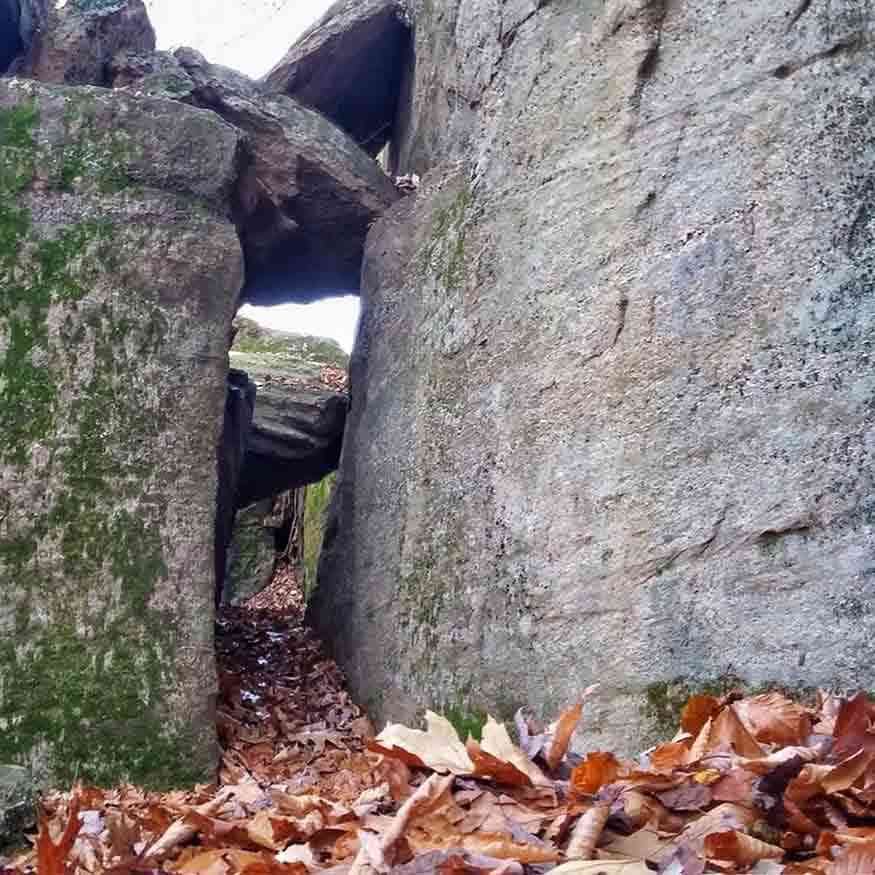


The trail
The trail is accessible from the end of Little Rock City Forest Road at the turn-around loop, which may be inaccessible in snow.
The trail loops through the rocks and intersects the North Country Scenic Trail, where it can be followed back to Little Rock City Forest Road.
If you are interested in the area’s geology, read more about the Cattaraugus County Geology Trail.
From the enchantedmountains.com website, “Today, we know that Little Rock City was not formed by glaciers, but actually formed through mountain building events known as orogenies. As sediment from surrounding areas was deposited over Rock City State Forest, the base for Little Rock City was formed. As hundreds of years passed, gravity erosion of the landscape began to separate non-resistant rock layers from those which were highly resistant, leaving us with the large boulders that are present today.”

More about Little Rock City
Cost: Free
Located in Little Valley, between Ellicottville & Salamanca, 2 hours and 15 minutes / 115 miles from Rochester (get directions).
More information: enchantedmountains.com
According to the DEC website, “The area tells the geologic history of Western New York. The conglomerate rock is younger and very different from Western New York’s bedrock. During the late Devonian period (circa 370 million years ago), this area was on the shore of an ancient sea. Here, streams flowing from the Acadian Mountains, in what is now New England and New Jersey, mixed with the sea. Sediment was transported by the streams and deposited by the sea currents. Occasionally, a red Jasper stone can be found among the conglomerate. According to the Theory of Continental Drift, all of North America was rotated 450 degrees clockwise during the Devonian period, meaning Lake Superior would have been due northwest of this area. This would allow sea currents to transport the Jasper pebbles into this area.
“Over time the conglomerate was buried under thousands of feet of sedimentary rock, similar to that of Allegany State Park in Pennsylvania. The overlying rock was then eroded during the Alleghanian Orogeny, or mountain building, uplifted Eastern North America (circa 290 million years ago). It was this event, resulting from the collision of North America and Africa, which formed the supercontinent Pangaea. Over time erosion released pressure allowing the conglomerate to expand and crack. These cracks, called joints, along with joints formed by horizontal compression during orogeny itself, resulted in two sets of intersecting perpendicular lines which, through weathering, widened to become the pathways separating the blocks.”
Explore More
Have you been to Little Rock City?
I’d love to hear from you—please share your thoughts and experiences in the comments below.


Help Support My Work
People often ask if I get free access to the places I visit. The answer is no—unless I’m invited to a special preview or offered behind-the-scenes access through my media role. Most of the time, I don’t even mention Day Trips Around Rochester, New York when I visit a place. I want to have the same experience you would.
I create and share this content because it brings me joy—and I hope it adds value to your adventures, too.
If my work has helped you explore and appreciate the Rochester area, please consider becoming a paid subscriber on Substack. You’ll receive an email whenever I publish new content and have the chance to connect with a growing community of local explorers.
Thank you for supporting my efforts to keep producing meaningful and helpful content.
Thank you!
Debi
Enjoy the Journey Together!


